Hawaii State History: a Political Overview

The state of Hawaii is rich with culture steeped in history. The history of the State of Hawaii begins with Polynesian settlement and continues with a period of British rule, an influx of immigrant populace and the eventual overthrow of the monarchy, before becoming a part of the United States of America.

Ancient Civilization

Volcanic eruptions formed the Hawaiian islands and they continue to grow in size thanks to ongoing volcanic activity. The location of the islands is between mainland U.S. and Asia, creating the ideal environment for a political power struggle. The exact time of the arrival of Polynesian inhabitants is unknown, but those initial Polynesian influences are a strong part of current Hawaiian culture.

Monarchy Rule

European immigrants began to settle in Hawaii in the early 16th century. In 1810, King Kamehameha I took control of the Islands, unifying the people, and began his nine-year rule. Kamehameha II took over in 1819 and violated the longstanding rules of kapu, the local religion on the islands, by eating with women. This break from the customs and traditions of the Hawaiian people sparked a revolt, which was quickly quashed.

The Beginning of Political Change

In 1820, English missionaries arrived and most of the Hawaiian citizens converted to Protestant Christianity, including the King’s stepmother. This brought about the creation of the Hawaiian Declaration of Rights, and the subsequent Constitution for the Hawaiian Islands, that changed the Island’s rule from that of an absolute monarchy to a constitutional monarchy in 1840.

Political Unrest and Revolution

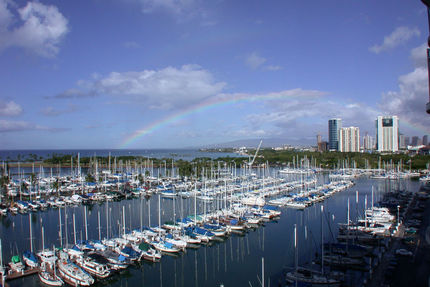
British Lord George Paulet captured the port of Honolulu Harbor on February 10, 1843 and forced King Kamehameha II to resign his position as ruler of Hawaii. Admiral Richard Thomas, Lord Paulet’s superior in the British Navy, later restored King Kamehameha II to his throne on July 31, 1843. During his restoration speech, King Kamehameha II stated “Ua mau ke ea o ka .?ina i ka pono” (The life of the land is perpetuated in righteousness). This statement later became the motto for the State of Hawaii.

On January 16, 1893, Queen Lili’uokalani’s attempt to revert to a state of absolute monarchy was thwarted by U.S. intervention at the request of European and American citizens of the Hawaiian Islands (known as the Committee on Safety). This military action was later deemed an abuse of U.S. power. The Republic of Hawai’i was established on July 4, 1894. A rebellion in response to the U.S. involvement in 1895 was unsuccessful.

U.S. Government

On July 7, 1898, Hawaii was officially annexed by the United States. The Hawai’i territory was created on February 22, 1900 as an official U.S. Territory. On December 7, 1941, Japanese forces attacked Pearl Harbor, O’ahu and initiated the United States entrance into World War II.

Hawaii was included as a U.S. state on August 21, 1959, becoming the 50th state of the Union. The state capital of Honolulu is located on the island of Oahu. The population of the state is just over 1,200,000.

This history of Hawaiian upheaval and political unrest continues today as some native Hawaiians continue to voice their displeasure at the involvement of the U.S. over 100 years ago. The Apology Resolution, signed by President Bill Clinton on November 23, 1993, was issued in response to this unrest. The Apology Resolution declared a formal request for forgiveness from the government of the United States for the military actions that interfered with the reinstatement of the monarchy ruling in 1893.

[?]
Share This Post - instructions included

Leave a Reply


Plan your dream vacation

Features you prefer
Activities you enjoy

For more options please use our advanced search tool